How Love Calculator By Name Works – The Complete Guide 2026
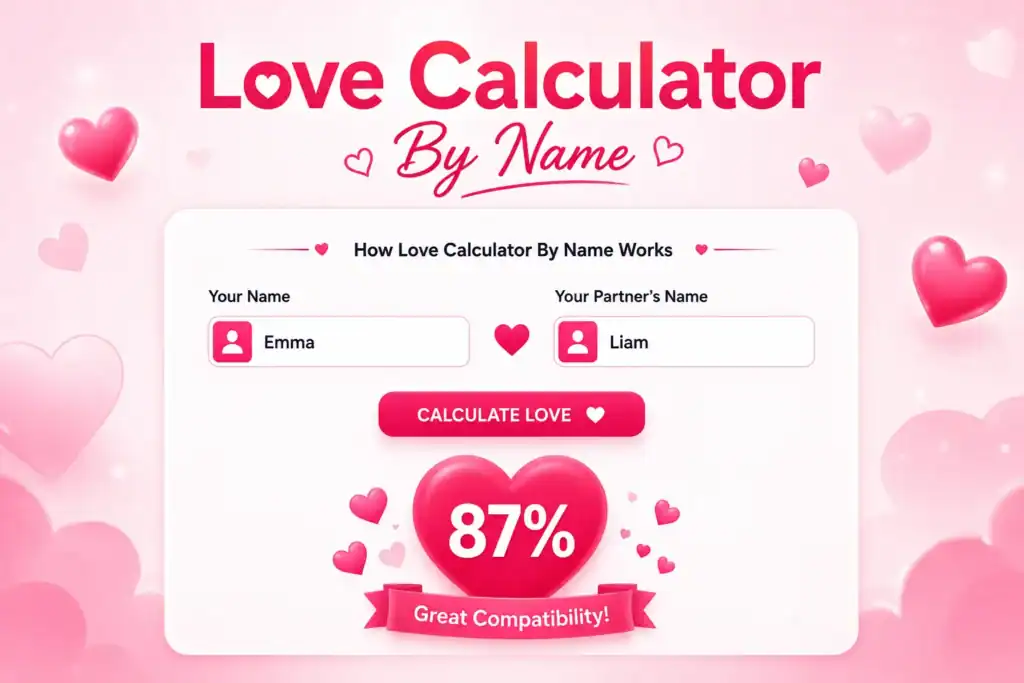
Type two names. Click calculate. Get a percentage.
Sounds simple, right? But what’s actually happening behind that love calculator by name?
Is it magic?
Is it science?
Or is it simply a fun way to turn two names into a compatibility score?
In this guide, we’ll explain how name-based love calculators work, where the idea came from, how names can be converted into numbers, why love calculator , and what your final percentage actually means.
A love calculator is an entertainment tool. It uses a predefined calculation method or algorithm to turn names into a numerical compatibility result. It cannot scientifically measure love or predict whether a relationship will succeed.
Where Did Love Calculators Come From?
The idea of calculating romantic compatibility existed long before modern websites.
In the 1990s and early 2000s, children and teenagers commonly played paper-and-pencil games involving names. One popular approach involved writing two names together, counting letters, crossing out matching characters, or using the letters in words such as “LOVE” to produce a playful score.
Eventually, these simple games moved online.
Early love calculator websites were extremely basic. You entered two names, clicked a button, and received a percentage. There was usually little explanation behind the result.
Today, the experience is much more polished. Modern compatibility calculators can be designed for mobile devices, provide explanations alongside the percentage, and create results that are easy to share.
The basic concept, however, remains the same:
Names → Calculation → Compatibility Score → Entertainment
It is important to note that there is no single historical “first” love calculator website or one universally accepted algorithm. Different websites have created their own formulas and methods over the years.
Step 1 – Converting Names Into Numbers
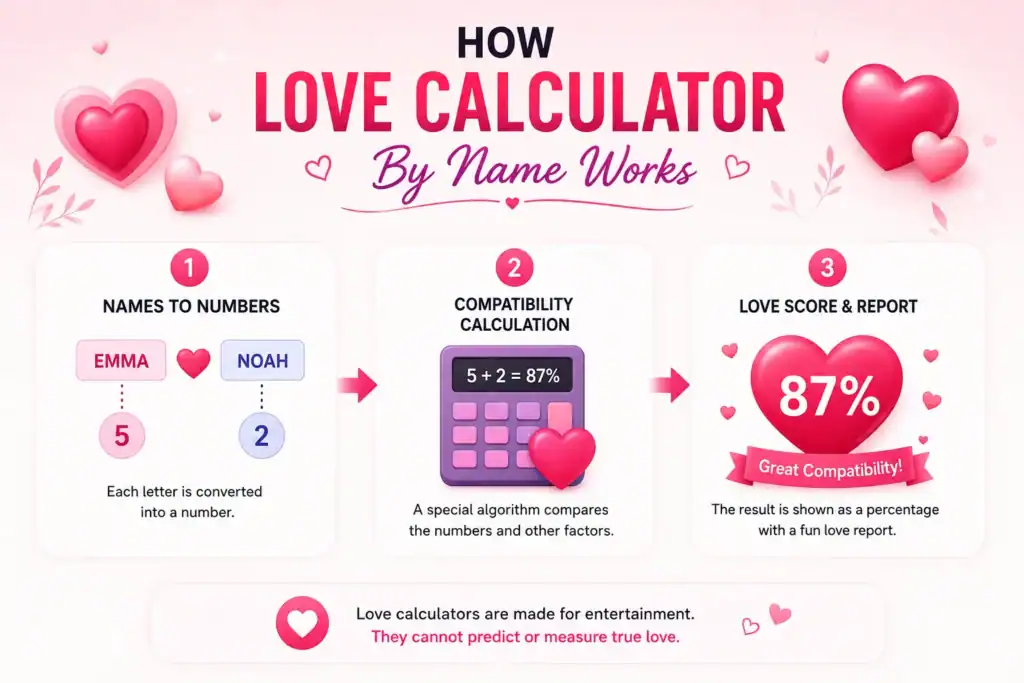
One approach sometimes associated with name-based compatibility tools is Pythagorean numerology.
In this numerology system, letters are assigned numerical values from 1 to 9.
| Letters | Number |
|---|---|
| A, J, S | 1 |
| B, K, T | 2 |
| C, L, U | 3 |
| D, M, V | 4 |
| E, N, W | 5 |
| F, O, X | 6 |
| G, P, Y | 7 |
| H, Q, Z | 8 |
| I, R | 9 |
For example, using this system:
EMMA
E = 5
M = 4
M = 4
A = 1
5 + 4 + 4 + 1 = 14
1 + 4 = 5
So EMMA produces the number 5 under this particular numerology method.
NOAH
N = 5
O = 6
A = 1
H = 8
5 + 6 + 1 + 8 = 20
2 + 0 = 2
NOAH therefore produces 2.
At this point, we have two numbers: 5 and 2.
However, this is only one possible way to process names. Not every love calculator uses numerology, and there is no scientific standard requiring calculators to use a particular formula.
Step 2 – The Compatibility Calculation
This is where different love calculators can produce completely different results.
Some tools simply combine numerical values. Others may use additional characteristics of the names or a custom formula created specifically for the website.
For example, a custom entertainment algorithm might consider factors such as:
1. Numerical Compatibility
The calculator may compare the numerical values produced from the two names.
The closer or more compatible the values are according to the formula, the higher the resulting score may be.
2. Letter Patterns
A calculator may also examine patterns within the two names, such as matching letters or shared vowels.
For example, two names containing several of the same letters could receive a small bonus in a custom entertainment formula.
3. Name Length
Some algorithms may consider the number of characters in each name.
A formula could compare a very short name with a much longer name differently from two names of similar length.
4. Other Formula Rules
A website may add additional rules, weighting systems, or adjustments to make its results more interesting.
The important point is that these rules are created by the calculator. They are not scientifically proven measures of romantic compatibility.
After the calculation is complete, the result is converted into a number between 0 and 100.
That number becomes your love percentage.
Step 3 – Why You Get a Report Instead of Just a Percentage
A percentage can be fun, but a number by itself doesn’t tell you much.
That is why modern love calculators may provide a short compatibility report alongside the score.
For example:
90–100%: A playful description might suggest strong chemistry.
60–89%: The report might describe good potential with some differences.
30–59%: The result might frame the pair as having an interesting or unpredictable dynamic.
0–29%: The report might use an “opposites attract” theme.
These descriptions should not be interpreted as psychological assessments.
There is also an interesting psychological reason why people can find these descriptions surprisingly relatable.
The Barnum effect, sometimes called the Forer effect, describes the tendency for people to perceive general personality statements as highly specific to themselves.
For example, a statement such as “You understand each other well but can sometimes struggle to communicate” could apply to many different couples.
That doesn’t mean the calculator has discovered something hidden about your relationship. It simply shows why generalized descriptions can feel personally meaningful.
What Makes a Love Calculator Fun?
There are many compatibility calculators online, but the experience can vary considerably.
A modern calculator can focus on making the process:
| Feature | Basic Calculator | Modern Calculator |
|---|---|---|
| Calculation | Simple percentage | Percentage + explanation |
| Design | Basic | Mobile-friendly |
| Results | Number only | Interactive result |
| Sharing | Often unavailable | Easy to share |
| Experience | Minimal | Fast and engaging |
The goal isn’t to make the result scientifically accurate— because a name calculator cannot scientifically measure love. The goal is to make the experience simple, enjoyable, and easy to understand. If you want to understand how reliable these results really are, read about love calculator accuracy .
Common Questions About the Algorithm
Can I Get 100% Every Time?
Not necessarily.
The result depends on the formula used by the calculator and the names you enter. Changing the spelling or using a nickname can produce a different result because the letters being processed have changed.
That’s part of the fun.
Does Using a Full Name Instead of a Nickname Change the Result?
It can.
For example, “Michael” and “Mike” contain different letters, so a calculator that processes every character will calculate them differently.
Neither result is more scientifically correct. They are simply different inputs.
Is the Same Algorithm Used Every Time?
A properly implemented calculator should return the same result when exactly the same inputs and calculation rules are used.
For example, if you enter the same two names today and enter exactly the same names later, a deterministic calculator should produce the same result.
That means the result doesn’t need to be randomly generated every time.
Do Love Calculators Actually Measure Love?
No.
A name-based calculator cannot measure emotions, trust, communication, attraction, shared values, or relationship quality.
It produces a numerical result based on its programmed rules.
Think of it as a game rather than a scientific test.
Do Love Calculators Predict the Future?
No.
A percentage cannot predict whether two people will stay together, get married, break up, or fall in love.
Relationships change because people change. Communication, circumstances, choices, and experiences matter far more than a calculator score. If you’re curious about the calculation itself, learn how to calculate love percentage by name.
The Psychology Behind Checking Compatibility Scores
If we already know that these calculators aren’t scientific, why do people enjoy them?
The answer is simple: curiosity and entertainment.
“What score will we get?”
That small question is enough to make the calculator interesting.
Curiosity
People naturally enjoy discovering unexpected results.
Validation
A high score can feel exciting, especially when you’re already interested in someone.
Conversation Starter
Sending a crush a message saying, “We got 94%!” can be much easier than directly asking how they feel.
Social Sharing
Compatibility scores are also easy to share with friends. A simple percentage can become a joke, conversation, or social media post.
The appeal isn’t necessarily that people believe the number is scientifically accurate. It’s that the result gives them something to talk about.
Mistakes People Make With Love Calculators
Taking the Result Too Seriously
Don’t make a major relationship decision because a calculator gave you 32%.
The score is entertainment, not professional relationship guidance.
Testing Dozens of Spellings
If you keep changing names until you reach 100%, you’re defeating the purpose of the game.
Choose the names you actually want to test and enjoy the result.
Comparing Your Score With Another Couple
A friend getting 98% doesn’t mean their relationship is “better” than yours.
Different calculators, formulas, names, and inputs can produce different results.
Treating the Score as Relationship Advice
A calculator cannot understand your relationship.
Use it as an icebreaker—not as advice.
How to Get the Most Fun From Your Result
Want the best experience?
- Use the names you actually want to compare. Whether that’s full names, first names, or nicknames depends on the calculator.
- Calculate once before experimenting. Don’t immediately change spellings just to chase a higher score.
- Read the report. The percentage is only one part of the experience.
- Share the result. Send it to your crush, partner, or friends and see what they think.
And most importantly, remember that the result is meant to make you smile.
So, How Does a Love Calculator By Name Works?
The basic idea can be summarized like this:
Names → Numbers or Letter Patterns → Algorithm → Percentage → Compatibility Report
Some calculators use numerology-inspired methods. Others use their own custom formulas. Because there is no universal standard, two different love calculators can give completely different percentages for exactly the same pair of names.
And that’s perfectly normal.
A love calculator is not magic, and it isn’t science. It’s a programmed entertainment experience built around our natural curiosity about relationships.
At the end of the day, no algorithm can calculate real love.
Real relationships are built through trust, communication, respect, shared experiences, laughter, patience, and effort.
But if a calculator gives you a 92% compatibility score, there’s certainly no harm in using it as an excuse to send someone a message. ❤️
Ready to have some fun? Enter two names into LoveCalc and see what percentage you get.